

STEM Passion: A journey inspired by women in science
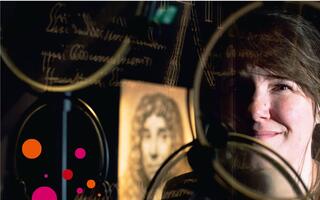
The artists Elisabetta Citterio and Claudia Cagliano have created portraits of more than 50 female researchers from nine countries. Twenty-five of them can be viewed in the "STEM Passion" exhibition from February 13, 2024 in the Rahel Hirsch Center for Translational Medicine Berlin.
Technology and knowledge transfer will account for two-thirds of future job openings. Yet, women are still underrepresented in STEM subjects. According to the UNESCO Institute for Statistics, one-third (33.3 percent) of researchers worldwide are women, and only 35 percent of STEM students are female. Though more than half of graduates and doctoral students in the life sciences are women, many give up their scientific careers. Only 15-20 percent attain a professorship or leadership position (Sources: UNESCO Women in Science; EU She Figures 2021).
There is no shortage of role models, as the two exhibition creators and artists Dr. Elisabetta Citterio and Claudia Cagliano demonstrate with their exhibition "STEM Passion." Beginning shortly after the International Day of Women and Girls in Science, the exhibition will be on display in Berlin for a month, drawing public attention to the achievements and leading role of women in science.
A diverse picture
From 2019 to 2023, Citterio and Cagliano interviewed and photographed over 50 female scientists working in a variety of roles at top international research institutions. These include Maria Leptin (President of the European Research Council, ERC), Edith Heard (Director of the European Molecular Biology Laboratory, EMBL) and Fiona Watt (Director of the European Molecular Biology Organization, EMBO), Asifa Akhtar (Vice President of the Max Planck Society) and Magdalena Skipper (Editor-in-Chief of the journal "Nature"). Berlin-based scientists from the Berlin Institute of Health at Charité (BIH) and the Max Delbrück Center are also featured.
- Professor Maike Sander, scientific director of the Max Delbrück Center
- Dr Susanne Wolf, group leader at the Max Delbrück Center and Charité scientist
- Dr Mina Gouti, group leader at the Max Delbrück Center
- Dr Michela Serresi, scientist at the Max Delbrück Center
- Professor Marina Mikhaylova, Humboldt University of Berlin
- Professor Sara Checa Esteban, Julius Wolff Institute (BIH)
- Professor Sophie van Linthout, BIH Center for Regenerative Therapies
The exhibition, featuring 25 selected portraits, will be on show in Berlin from February 14 to March 12, 2024, and can be visited weekdays between 7 a.m. and 6 p.m. in the foyer of the Rahel Hirsch Center for Translational Medicine, Luisenstr. 65, 10117 Berlin (Campus Charité Mitte).
Perspectives on the exhibition
Professor Maike Sander, scientific director of the Max Delbrück Center, says: "'STEM Passion’ is really about spotlighting a few of the many brilliant women shaping science today, pushing the boundaries of research and innovation. It's a glimpse into their lives, their drive, and their stories. And it's their personal journeys, the unique paths they've taken, and who they are that make their stories so compelling. Being featured among them is a real honor for me."
Professor Christoper Baum, scientific director of the Berlin Institute of Health at Charité (BIH), says: “Women having equal opportunity in science should just be a given, as should their having real visibility in science. I’m delighted that this exhibition is helping highlight that and bringing the achievements of so many incredible female scientists into focus for everyone to see."
About the artists

Dr Elisabetta Citterio, photographer and creator of the project, is herself a molecular biologist. She researches the molecular mechanisms that maintain genome integrity — crucial in cancer, for example. In addition to science, she loves exploring the world through photography. She studied biology at the University of Milan and completed her doctorate in molecular genetics at the Erasmus University Rotterdam. She has also led research projects at international institutes in the Netherlands and Italy. Citterio is a research associate at the University of Milano-Bicocca in Milan. She studied photography at Fotogram in Amsterdam and Il Diaframma in Milan with Giuliana Traverso.
Claudia Cagliano, co-creator of the project, is a lecturer and communications consultant. She is an associate professor at the IED -European Design Institute and at the Holden Academy Course in Turin. She is also a member of the Athena Network of the Pubblicità Progresso Foundation and works on sustainable development and social innovation, particularly the empowerment of women. Cagliano is interested in the relationship between communication, media and the emergence of gender stereotypes. She studied philosophy at the Catholic University of Milan with a specialization in communication and holds a master's degree in corporate communication from the UPA Ca' Foscari in Venice. She has also worked as a project manager and strategy developer in international advertising agencies and has developed coaching programs.
Press preview
Media representatives can preview the exhibition on February 13 between noon and 1 p.m. The artists will offer a tour of the exhibition and will be available for interviews.
Rahel Hirsch Center for Translational Medicine, Luisenstr. 65, 10117 Berlin (Campus Charité Mitte)
Official opening
Journalists are cordially invited to the official opening of the exhibition on February 13, starting at 4 p.m.! The program will include:
-
Prof. Dr. Maike Sander
Scientific Director and Chairwoman of the Board, Max Delbrück Center -
Prof. Dr. Heike Graßmann
Administrative Director, Max Delbrück Center -
Prof. Dr. Christopher Baum
Chairman of the BIH Board of Directors and Director of the Department of Translational Research at Charité -
Prof. Dr. Kathrin Zippel
Einstein Professor of Sociology with a focus on Gender Studies at the Institute of Sociology of the Freie Universität Berlin and member of the Cluster of Excellence SCRIPTS -
Dr. Elisabetta Citterio
Creator of the exhibition (Italy/Netherlands) -
Claudia Cagliano
Co-creator of the project (Italy)
Rahel Hirsch Center for Translational Medicine, Luisenstr. 65, 10117 Berlin (Campus Charité Mitte)
The exhibition was organized by the equal opportunity officers of the Berlin Institute of Health at Charité (BIH) and the Max Delbrück Center. It is generously supported by BR50 and the collaborative research centers SFB1315, SFB 1444, SFB 1470, SPP2395.
Further information
- Program for the exhibition opening
- If you would like to attend the official opening or the preview as a media representative, please register by email by Tuesday, February 13, at 9 a.m.: [email protected]
- Selected images from the exhibition will be made available to the media from the date of the opening.

Contacts
Konstanze Pflüger
Head, Communications
Berlin Institute of Health at Charité (BIH)
+49 (0)30 450 543 343
[email protected]
Jana Schlütter
Editor, Communications
Max Delbrück Center
+49 30 9406-2121
[email protected] or [email protected]
The Max Delbrück Center for Molecular Medicine in the Helmholtz Association (Max Delbrück Center) is one of the world’s leading biomedical research institutions. Max Delbrück, a Berlin native, was a Nobel laureate and one of the founders of molecular biology. At the locations in Berlin-Buch and Mitte, researchers from some 70 countries study human biology – investigating the foundations of life from its most elementary building blocks to systems-wide mechanisms. By understanding what regulates or disrupts the dynamic equilibrium of a cell, an organ, or the entire body, we can prevent diseases, diagnose them earlier, and stop their progression with tailored therapies. Patients should be able to benefit as soon as possible from basic research discoveries. This is why the Max Delbrück Center supports spin-off creation and participates in collaborative networks. It works in close partnership with Charité – Universitätsmedizin Berlin in the jointly-run Experimental and Clinical Research Center (ECRC), the Berlin Institute of Health (BIH) at Charité, and the German Center for Cardiovascular Research (DZHK). Founded in 1992, the Max Delbrück Center today employs 1,800 people and is 90 percent funded by the German federal government and 10 percent by the State of Berlin.